
Lorcan McLaren
PhD Researcher
University College Dublin
I am a PhD researcher in computational social science at University College Dublin, funded by a Taighde Éireann - Research Ireland Government of Ireland scholarship. Based in the Connected_Politics Lab under the supervision of James P. Cross, my research employs text-as-data approaches to examine political communication, with a particular focus on the climate crisis. Previously, I was supported by the Iseult Honohan scholarship and served as a Climate Fellow at the UCD Earth Institute.
Prior to my doctoral studies, I completed a BA in Computer Science, Linguistics and French at Trinity College Dublin and an MSc in Politics and Data Science at University College Dublin, complemented by two years of industry experience as a data analyst.
Research
Working Papers
[Draft Available]
Abstract
Climate change is often cast as a psychologically distant threat, diffuse in cause, remote in its worst consequences, and weak in its everyday experiential signal. This paper asks whether nearby extreme weather changes how Members of the European Parliament (MEPs) frame climate change: not whether they discuss it more, but whether they present its impacts as proximate, near in space and time, attached to identifiable European communities, rather than as distant problems for faraway people and future generations.
The central argument distinguishes the meteorological signal of extreme weather from the social-impact narrative that disaster recording produces. Heatwaves that were meteorologically real but never crystallised into a recorded disaster are followed by a gradual shift toward more proximate and more specific climate framing among nearby MEPs, surfacing with a lag of two to three years. Heatwaves that did produce a recorded disaster, the kind of recorded-disaster set a conventional disaster-politics design would analyse, produce no comparable response. What activates legislators' climate framing is the regional footprint of a hot summer travelling through weather coverage and lived experience, not the discrete-event impact narrative that dominates standard disaster registers, and it works on how climate is narrated, not how much. The political signal of climate change, on this evidence, reaches elite rhetoric through the slow metabolism of climate-coded weather rather than through the acute focusing events the literature has emphasised.
[Under Review]
AbstractPreprint
Political scientists are rapidly adopting large language models (LLMs) for text annotation, yet the sensitivity of annotation results to implementation choices remains poorly understood. Most evaluations test a single model or configuration; how task and model choice, model size, learning approach, or prompt style interact, and whether popular "best practices" survive controlled comparison, are largely neglected. We evaluate these pipeline choices, testing six open-weight models across four political science annotation tasks under identical quantisation, hardware, and prompt-template conditions. Our central finding is methodological: interaction effects dominate main effects, so seemingly reasonable pipeline choices become consequential researcher degrees of freedom. No single model, prompt style, or learning approach is uniformly superior, and the best-performing model varies across tasks. Two corollaries follow. First, model size is an unreliable guide to both cost and performance: cross-family efficiency differences are so large that some larger models are less resource-intensive than much smaller alternatives, while within families mid-range variants often match or exceed larger counterparts. Second, widely recommended prompt engineering techniques yield inconsistent and sometimes negative effects. We use these results to develop a validation-first framework with a principled ordering of pipeline decisions, reporting standards, and open-source tools.
[Under Review]
Abstract
When politicians describe climate change as a threat to future generations in faraway places, they render it abstract; when they speak of floods at home and livelihoods at stake today, they bring it close. Experimental research shows this distinction matters: proximate framing increases concern and support for action, but these literatures rarely speak to each other. What determines whether a legislator chooses to proximise? I address this question using over 35,000 European Parliament speeches from 2014 to 2024, classifying whether legislators mention environmental impacts, frame them as specific or universal, and situate them as proximate or distant. Gender and left-right ideology emerge as the most consistent predictors: female and left-leaning legislators discuss impacts more frequently and frame them as closer. Legislators respond to domestic climate salience, but EU integration position does not shape climate rhetoric. The paper shows that generative language models can efficiently label training data for fine-tuned classifiers.
Publications
Proceedings of the 11th IEEE International Conference on Cognitive Infocommunications (CogInfoCom), 2020.
PaperOpen AccessSource Code
Proceedings of the 11th IEEE International Conference on Cognitive Infocommunications (CogInfoCom), 2020.
PaperOpen Access
Projects
AbstractDocumentationPython Package
A Python package for computational social science that benchmarks local LLM annotation runs against human labels across model choice, prompt style, example use, chat mode, reasoning mode, and sampling settings.
AbstractAppDocumentation
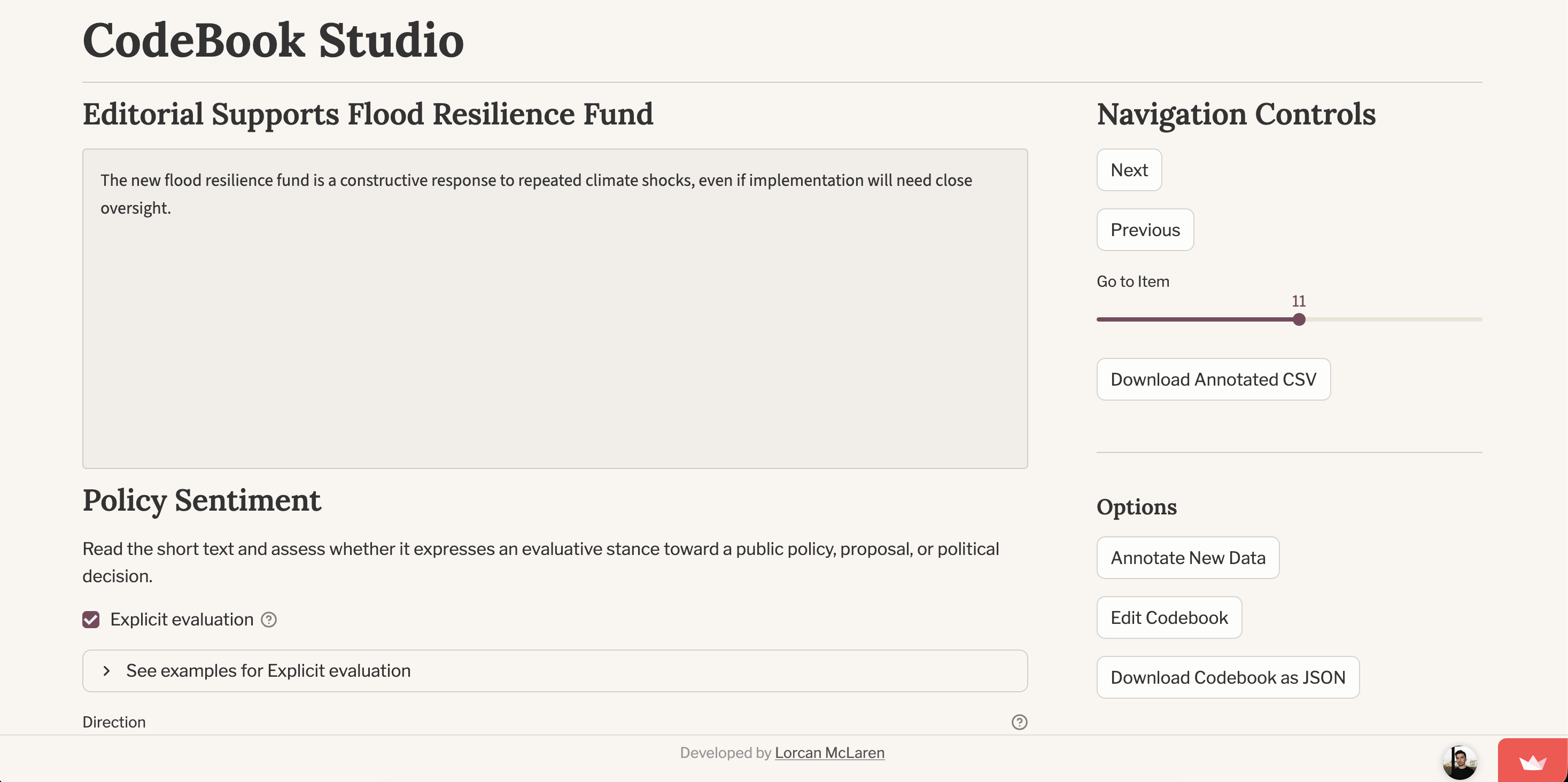
A browser-based annotation tool for computational social science. Define a codebook, annotate texts, adjudicate disagreements, and export labelled data for LLM benchmarking in CodeBook Lab.
Teaching
Module Instructor
- AI and Large Language Models, Postgraduate (Spring 2025, 2026)
SyllabusCourse Website
Teaching Assistant
- Introduction to EU Politics, Undergraduate (Autumn 2023, 2024)
- Research Methods in Political Science, Undergraduate (Spring 2024)
Contact
For inquiries, collaboration opportunities, or to discuss my work, feel free to reach out via email.